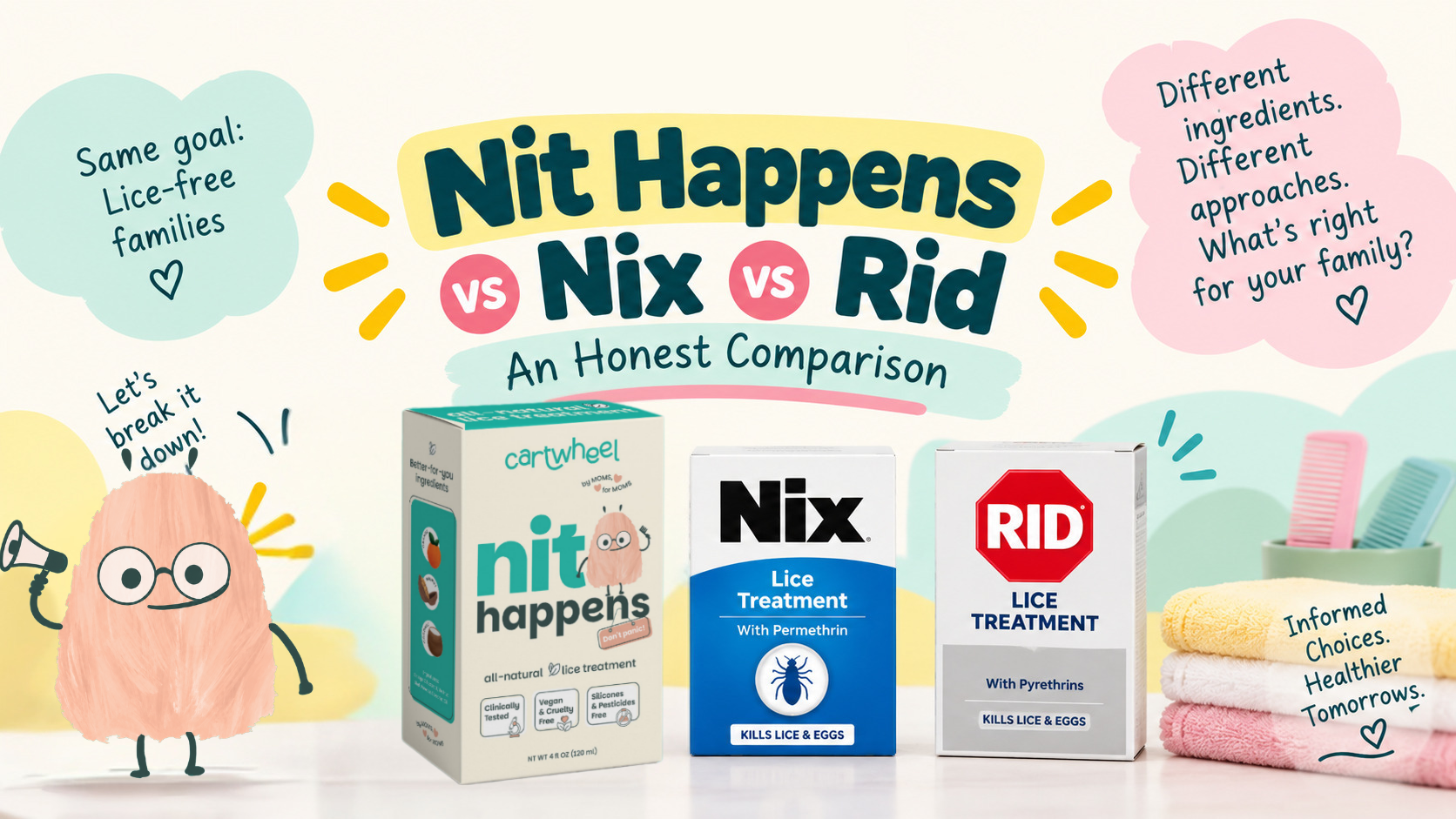
Nit Happens vs. Nix vs. RID: An Honest Comparison
Is Nix or RID better?
Short answer: neither works reliably anymore, and the difference between them is small. Nix (permethrin 1%) and RID (pyrethrins with piperonyl butoxide) are both pyrethroid class insecticides, and a 2016 survey of 48 states found that 98.3% of US head lice carry the gene mutations that make that whole class much less effective. Published cure rates in resistant populations run 15 to 55% for permethrin and 18 to 22% for pyrethrins. If you must choose between the two, Nix has the slightly better record and leaves a residue on the hair for a few days; RID does not. But the better question in 2026 is whether to use a pyrethroid at all. A treatment that works physically, by coating and dehydrating lice and loosening nits so a metal comb removes them, does not depend on the lice being susceptible. That is how Nit Happens works, which is why its trial result (89% lice free at day 15) sits well above either product.
Side-by-side comparison
| Feature | Nit Happens | Nix | RID |
|---|---|---|---|
| Active ingredient | None (mechanical action) | Permethrin 1% | Pyrethrins 0.33% + PBO 4% |
| Mechanism | Physically disrupts lice and nit attachment | Insecticide (neurotoxin) | Insecticide (neurotoxin) |
| Cure rate, 1 treatment | 54% lice-free at Day 8¹ | 15–55% | 18–22% |
| Cure rate, up to 2 treatments | 89% ITT; 95.8% when two investigator judged re-infestations are excluded¹ | 15–55% (resistance limits gains) | 18–22% (similar) |
| Pesticide-free | ✅ Yes | ❌ No | ❌ No |
| Resistance issue | None (physical mechanism) | ⚠ 42+ U.S. states (CDC, 2025) | ⚠ Similar resistance pattern |
| Safe for eczema/sensitive skin | ✅ Preferred option | ⚠ Caution advised | ⚠ Caution advised |
| Age approval | Per label guidance | Ages 2+ | Ages 2+ |
| Available at Walgreens | ✅ Yes | ✅ Yes | ✅ Yes |
| Clinical study | IRB-approved (Villar & Rivera, 2020) | Multiple published trials | Multiple published trials |
Why do Nix and RID have such low cure rates?
Permethrin and pyrethrins are neurotoxins that worked well when they were introduced in the 1980s and 1990s. The problem: lice develop genetic resistance to neurotoxins over time through a mechanism called knockdown resistance (kdr). According to the CDC (2025), super lice (lice with genetic mutations that make them resistant to permethrin) have been identified in at least 42 of the 48 continental U.S. states.
In the most rigorous published clinical trial of permethrin (Burgess et al., BMC Dermatology, 2013), the cure rate was just 14.9%, meaning more than 85% of participants still had lice after a two-application course of Nix. Families who use them as directed and still find live lice a week later are not doing anything wrong. The lice have evolved past the treatment.
How is Nit Happens different?
Nit Happens uses a fundamentally different mechanism. There's no chemical active ingredient and no neurotoxin. The kit works in five steps:
- Apply the treatment gel to wet hair. This loosens the bond between nits and the hair shaft
- 10-minute wait
- 15–30 minutes of thorough brushing with the applicator brush to physically remove lice and nits
- Second 10-minute wait
- Rinse and removal with the shampoo gel
Because the mechanism is physical, not chemical, lice cannot develop resistance to it. There are no pesticides and no synthetic chemicals that lice can evolve around. This is why Nit Happens' cure rates hold up in the real world, where Nix and RID's don't.
What about the comparison claim: "over 2x more effective"?
Based on the H.A.L.T. clinical study (Villar & Rivera, 2020), Nit Happens achieved an 89% intent-to-treat cure rate at Day 15. Compared to the median published cure rates for permethrin (Nix) and pyrethrins (RID) in modern resistant lice populations, this exceeds 2x more effective.¹
The most rigorous published clinical trial of permethrin (Burgess 2013) found a 14.9% intent-to-treat cure rate, approximately 6x lower than Nit Happens' 89%. Even against the mid-range permethrin estimates in Meinking et al. (2004–2010), which put permethrin cure rates at roughly 28–55%, Nit Happens' 89% represents more than 2x the effectiveness. This is not a head-to-head study.¹
Where to buy
Nit Happens is available at Walgreens locations nationwide and on Amazon. To find a store near you with the kit in stock tonight, see our Walgreens store locator guide.
The bottom line
Nix and RID are pesticide-based treatments with declining effectiveness due to widespread lice resistance across the U.S. In the most rigorous published trials, permethrin cure rates have fallen as low as 14.9%. Nit Happens, a pesticide-free mechanical-action kit, achieved an 89% cure rate in an IRB-approved clinical study, with no adverse events reported and no resistance possible.
Sources
- Villar ME, Rivera SR. H.A.L.T. Healthy Alternative Lice Treatment Study. IRB-approved by IntegReview IRB, Austin, TX. December 3, 2020.
- Burgess IF, Brunton ER, Burgess NA. BMC Dermatology. 2013;13:5.
- Meinking TL, et al. Pediatric Dermatology. 2004;21(6):670–674.
- Centers for Disease Control and Prevention. Parasites, Lice, Head Lice: Treatment. cdc.gov. Updated 2025.
- Gellatly KJ, et al. Journal of Medical Entomology. 2016;53(3):653–659.
- Pariser DM, et al. New England Journal of Medicine. 2012;367(18):1687–1693.
- Heukelbach J, et al. BMC Infectious Diseases. 2008;8:115.
Questions parents ask
Does Nix still work?
Sometimes, but far less often than its label suggests. The 1% permethrin in Nix was over 95% effective in the 1980s. In recent US trials against resistant lice, intent to treat cure rates have ranged from about 15% to 55%. If Nix did not work for you, it is unlikely a second box will.
Why does RID not work?
RID uses pyrethrins, natural cousins of permethrin, boosted with piperonyl butoxide. Lice that carry knockdown resistance mutations shrug off both, and nearly all US lice now carry them. RID also does not kill eggs, so missed nits hatch a week later.
Can I use Nix and RID together or back to back?
No. They are the same class of insecticide, so stacking them adds pesticide exposure without adding effectiveness. The American Academy of Pediatrics advises switching to a different type of treatment when a pyrethroid fails, not repeating it.
What works instead of Nix or RID?
Options that do not rely on the lice being susceptible: a physical treatment such as Nit Happens ($34.99 per person, Walgreens, Amazon and gocartwheel.com), dimethicone based products, or a prescription such as spinosad or ivermectin lotion from your pediatrician. Whatever you choose, a metal nit comb and a second check a week later matter as much as the bottle.
Further reading: for a neutral, sourced comparison of every lice treatment product category, see licetreatments.org, the educational site Cartwheel publishes.